
Two people can type the same company name into a search bar and end up talking about different businesses. That is increasingly common in global markets, where “trading” can mean anything from commodities logistics to stock brokerage to retail brands using the word as a label.
Searches for emirates trading agency show how quickly confusion can spread when a name resembles other entities in different countries or industries. The practical stakes are not small. A mistaken identity can derail a supplier onboarding, lead to payments sent to the wrong counterparty, or cause an investor to confuse a legitimate firm with an unrelated operation. In a market where deals can move across borders in hours, basic verification has become part of the cost of doing business.
Part of the challenge is structural. Many firms use generic descriptors “trading,” “corporation,” “agency,” “group” that travel well across languages and jurisdictions. In parallel, social platforms and online marketplaces make it easy for third parties to borrow a similar brand look, create a near-match web domain, or circulate screenshots that appear official. Regulators in multiple countries have warned that scams often rely on impersonation tactics and off-platform contact that makes it harder to trace accountability, a pattern covered in this guide on scam links.
The result is a modern risk that looks mundane: name collision. Yet it shows up in real workflows bank onboarding, procurement, brokerage account openings, and even routine checks like “how many trading days in a year” when teams are trying to time settlements and reporting cycles.
Name collisions are rising as “trading” becomes a catch-all label
The phrase “Emirates Trading Agency” itself can point to different corporate realities depending on what a reader means and where they are looking. One widely referenced entity is Emirates Trading Agency described as a UAE conglomerate with activities spanning multiple sectors, often associated with “ETA” branding in the region. Company profiles describing that history appear in public listings such as LinkedIn.
But “Emirates Trading Agency” can also appear as a separate legal name in other jurisdictions. In the UK, for example, “EMIRATES TRADING AGENCY LIMITED” appears in the Companies House register, which is a reminder that registry identity is not the same as a search-engine identity.
This is where misunderstandings begin. In casual online conversation, a name match can be treated as proof. In compliance and payments, it is not. Firms and banks typically rely on legal entity identifiers such as registration numbers, addresses, directors, and where relevant regulated status rather than brand language alone.
The same dynamic shows up in other search phrases that blend “trading” with a generic corporate form. The keyword fortune trading corporation is a useful example. That name exists in more than one context, including a UK-registered company with a specific company number and registered office shown in the public register. The presence of a filing record is not, by itself, proof of scale or reputation. It is simply an anchor for identity useful when the goal is to ensure the right counterparty is on the other side of an invoice or contract.
Confusion also occurs when “trading” has nothing to do with finance. Outback Trading Company is best known as an outdoor and western apparel brand, selling items like oilskin jackets and related clothing, which can surface in searches that were never intended to be about markets. The brand describes itself as a supplier of all-weather apparel on its own site.
That overlap matters because many frauds are opportunistic. When users are already uncertain about what they are looking at, it becomes easier for bad actors to present a lookalike identity as “the right one,” especially when contact moves quickly to messaging apps.
Even the phrase tyreek hill trading illustrates how ambiguous a search term can be. In many contexts it refers to sports-fan discussions about player trades, not financial trading. At the same time, global fraud reporting shows that scam operations frequently recruit victims via messaging groups and pitch them on “platform” logins and deposits, a broad pattern repeated in local reporting about WhatsApp-based trading pitches. The key point is not that a public figure is involved, but that name-driven searches can pull people into unrelated funnels.
What the market calendar has to do with verification
Name confusion is only one part of the risk picture. Another is timing. When companies talk about “trading days,” they may be talking about exchange open days, settlement cycles, or operational cutoffs at banks and brokers. Those details matter for payments, reconciliations, and any contract tied to market pricing windows.
A common question embedded in everyday search behavior is how many trading days in a year. For US equities, the number is typically around 252, but it shifts slightly depending on how weekends and holidays fall. The key is that the number is not a fixed constant; it is calendar-dependent and market-specific.
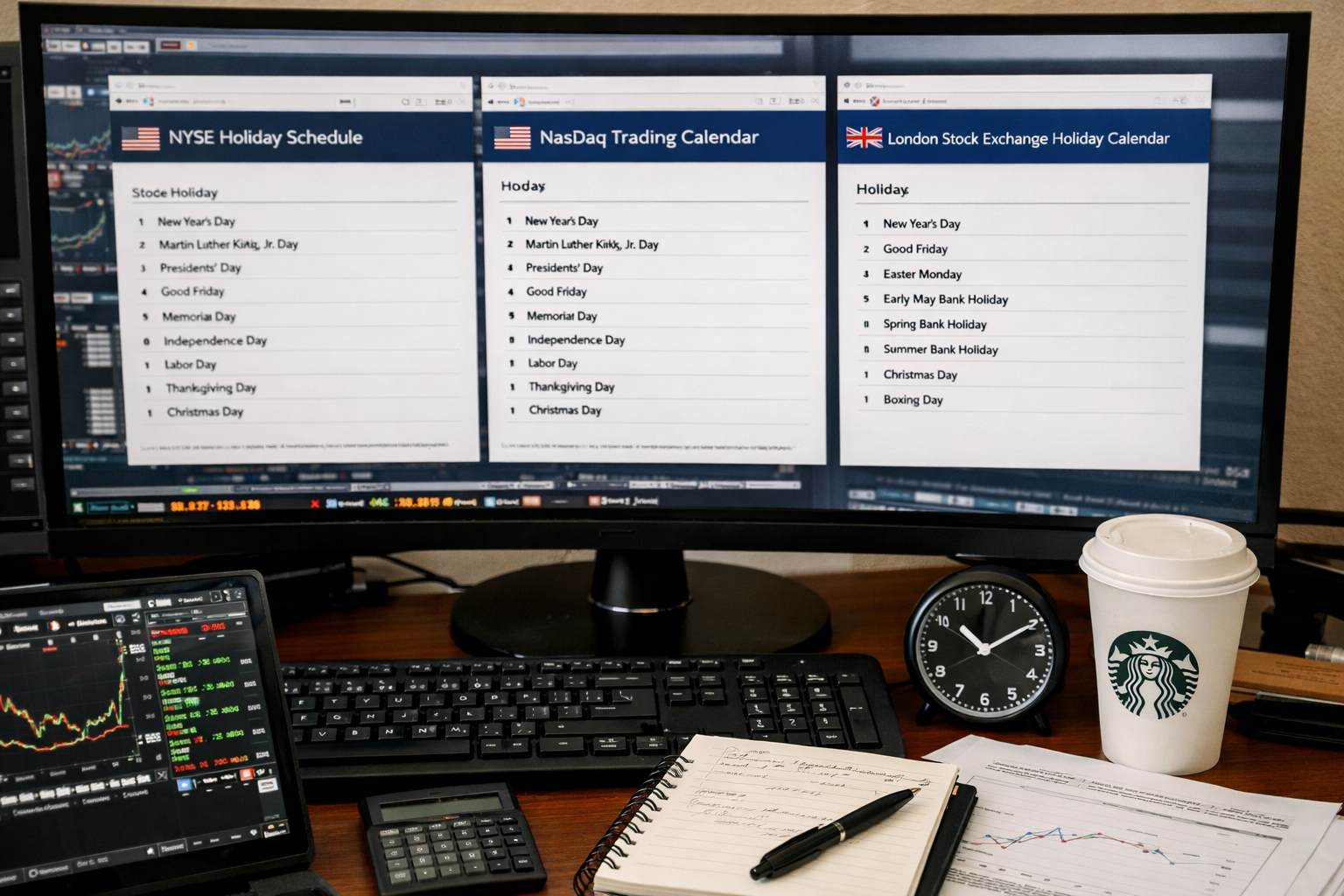
For 2026, major US equity venues publish their holiday schedules publicly. Nasdaq’s trader calendar lists standard closures such as New Year’s Day, Martin Luther King Jr. Day, Presidents Day, Good Friday, and others, along with a few early-close sessions. The NYSE also publishes hours and calendars that show the same pattern of holiday closures.
The UK calendar differs. London’s market holidays align with bank holidays and include Good Friday and Easter Monday, along with May and August bank holidays and specific Christmas-period closures.
Why does this matter for a story about a company name? Because many disputes and operational errors happen at the edges: a payment sent assuming markets are open, a contract that references “next trading day” without specifying which market, or a reconciliation that breaks because one region was closed while another traded. In cross-border relationships where a firm in the Gulf might be coordinating with UK and US counterparties calendar mismatch becomes an avoidable friction point.
It also matters for people evaluating claims online. Scams and misleading pitches sometimes use urgency “only today,” “market closes in hours,” “profits credited overnight” without clearly stating which market calendar they are referencing, or whether any regulated venue is involved. Without making any assumptions about a particular firm, the broader lesson is straightforward: when timing claims are vague, verification becomes more important.
A simple table for separating identity from branding
Readers trying to make sense of similarly named “trading” entities often benefit from a basic separation: brand terms versus verifiable identifiers. The table below summarises a cautious way to think about it, without relying on unverified claims about any single organisation.
| What you see in a search | What it could mean | What is usually verifiable from official sources | Why it matters |
|---|---|---|---|
| “Emirates Trading Agency” | Could refer to a UAE conglomerate profile or a separate legal entity with a similar name in another country | Corporate registry entries, addresses, officers/directors, official channels | Prevents paying or contracting with the wrong party |
| “Fortune Trading Corporation” | Could be a specific registered company, or a different firm using similar naming | Company number, registered office, filing history in the relevant jurisdiction | Helps confirm you are reviewing the correct entity |
| “Outback Trading Company” | Often a retail apparel brand, not a financial or commodities trading house | Official brand site, business contact pages, product catalog context | Avoids misreading a retail brand as a market intermediary |
| “How many trading days in a year” | Calendar question that varies by exchange and year | Published holiday calendars from exchanges | Avoids timing errors in operations and settlement expectations |
What to watch next: why this issue is unlikely to fade
Several long-running shifts are pushing name confusion from a nuisance into an operational risk.
First, cross-border commerce is more accessible than it used to be. Small companies can source goods globally, open accounts with service providers in other jurisdictions, and market internationally with limited physical footprint. That expands the surface area for near-identical naming.
Second, market structure is in flux. Trading hours and venue competition have become recurring themes in financial centres, including debate in the UK about whether extended hours could make markets more competitive. Whether or not those changes happen quickly, the attention on “trading time” increases the number of casual users searching for trading calendars, holidays, and “open/closed” status exactly the conditions where brand confusion thrives.
Third, impersonation tactics are cheap. Setting up pages, profiles, and message funnels costs very little compared with the potential payoff from a single misdirected payment or compromised onboarding. That is why regulators continue to stress caution around unsolicited offers and off-platform contact, and why public-facing education about scams remains relevant to ordinary business checks, not just investors. This broader risk is outlined in regulators warn coverage that focuses on how fraudulent links and lookalike prompts spread.
None of this means that a firm with “trading” in its name is suspect. The term is widespread for legitimate reasons, including historical naming conventions in commodities, shipping, and wholesale. The point is that modern verification has to be more specific than a logo, a profile, or a confident message.
A practical mindset that often helps is to treat a name search as a starting clue, not a conclusion. If a discussion thread or a buyer review mentions a company in passing, it can be useful context, but it should not be the sole foundation for a financial decision or a supplier relationship. That is true whether the link is a corporate registry entry or a community post such as this Reddit thread that reflects user experience in a retail context rather than audited corporate disclosures.
For businesses and readers trying to keep it simple, the question to carry forward is basic: “Which exact entity is this?” If the answer is not clear, the risk is not theoretical. It is administrative, and it can be expensive.
FAQ
Q1) Is “Emirates Trading Agency” one specific company worldwide?
Not necessarily. The same or similar name can appear in different jurisdictions and contexts. Corporate registries and official company identifiers help distinguish entities.
Q2) What does “Fortune Trading Corporation” refer to in the UK context?
In the UK, “FORTUNE TRADING CORPORATION LTD” appears in Companies House with a company number and registered office address listed in the public record.
Q3) How many trading days are in a year for US and UK stock markets?
It varies by year and exchange holiday calendars. US and UK exchanges publish holiday schedules that determine the number of open sessions in a given year.
Q4) Is Outback Trading Company a financial trading firm?
Outback Trading Company is commonly known as an outdoor and western apparel brand on its official site, not a financial exchange or brokerage.
Q5) Why do scams often involve messaging groups and “trading platforms”?
Public reporting has described schemes where victims are added to messaging groups and directed to register on platforms presented as investment services. Patterns vary, but the channel is commonly used because it is fast and hard to police.
Conclusion
The attention around emirates trading agency shows how easily a familiar-sounding name can carry different meanings across borders, industries, and online spaces. In today’s market environment, where global calendars differ and “trading” is used to describe everything from retail brands to regulated market activity, names alone are not reliable signals.