
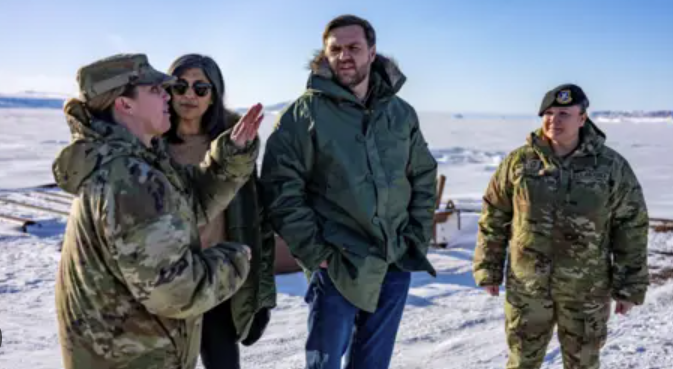
When U.S. Vice President JD Vance travelled to Greenland and argued that Denmark was not doing enough to keep the island safe, the comments landed far beyond the Arctic. They fed a wider debate about security, minerals and influence in a region that investors often associate with long-term themes: climate change, new shipping routes, and the scramble for resources used in modern electronics and energy systems.
The immediate market impact from headlines about Greenland can be hard to pin down. There is no “Greenland stock index,” and many of the commercial opportunities discussed in political arguments are years away from becoming real projects. But the direction of policy matters: it can affect defence procurement, risk pricing in transatlantic ties, and the permitting climate for mining and infrastructure across the Nordic and North Atlantic region.
In January, President Donald Trump again described Greenland as critical to U.S. security and said Denmark could not be relied on to protect it, after a meeting involving Vance and senior Danish and Greenlandic officials. Danish and Greenlandic representatives repeated that Greenland is not for sale and framed the issue as one of sovereignty among allies.
For a global audience, the dispute also pulls Greenland into a broader story about how governments are rethinking supply chains and strategic geography. That includes how NATO countries talk about the Arctic, how Europe responds to U.S. pressure, and how China and Russia are referenced in the conversation even when the underlying claims are contested or presented without detail.
Why Greenland keeps coming up
Greenland is an autonomous territory within the Kingdom of Denmark, with self-government arrangements that have expanded over time. Denmark still handles areas such as foreign affairs and defence, while Greenlandic authorities control many domestic matters and natural resources. That division is part of what makes any external “ownership” language politically explosive: it touches governance, identity and the right to decide future development.
The argument from Washington, in public terms, tends to centre on security and strategic access. Vance’s March 2025 visit to the U.S. military facility at Pituffik in northern Greenland highlighted that security angle. He said the United States did not have immediate plans to expand its military presence on the ground, but talked about investing in assets such as ships and icebreakers, while criticising Denmark’s level of commitment.
Greenland’s political leadership has responded by stressing respect and self-determination. After Vance’s visit, Greenland’s prime minister at the time, Jens-Frederik Nielsen, said the trip signalled a “lack of respect,” a phrase that quickly became a shorthand for the local political mood in Nuuk and for how officials framed the dispute abroad.
That context helps explain why search terms like “greenland pm defends against us disrespect” have gained traction online. It is not only about one visit, but about tone and leverage, and whether Greenland is being treated as a partner or as an object in a power contest.
For readers looking up basics, the cap city of Greenland is Nuuk. It is also Greenland’s largest city and the centre of government, business and most national institutions.
But Nuuk is not the only place that matters to this story. When people search “cities in Greenland,” they are often trying to understand the scale of the population and how dispersed it is. Outside Nuuk, larger towns include Sisimiut and Ilulissat, among others, with many smaller settlements spread across a vast coastline. That geography is one reason infrastructure projects in the Arctic are expensive, slow and politically sensitive.
The discussion also plays out against a backdrop of earlier disputes. In 2019, Denmark’s prime minister called the idea of selling Greenland to the United States “absurd” after reports of U.S. interest. The phrasing from that period is often recalled now as a baseline position: Greenland is not for sale, and Denmark says it is ultimately Greenland’s future to decide.
Security, resources and the investor lens
From an investor standpoint, Greenland’s story sits at the intersection of three themes.
First is defence and surveillance. In late January, Greenland’s prime minister said the region needed more surveillance and security, referencing Russia’s posture in the far north, during a meeting in Paris alongside Denmark’s prime minister and France’s president. He also described “red lines” in discussions with the United States, without giving details publicly.
Defence-related spending tends to show up in budgets, procurement contracts and industrial planning long before it shows up in GDP data. So when political leaders emphasise Arctic security, investors often interpret it as another sign of a longer cycle: more spending on monitoring, communications, satellites, airfields, ports and the vessels needed to operate in icy waters.
Second is minerals and supply chains. Greenland is frequently described as mineral-rich, and that label is one reason it is drawn into debates about “critical minerals” used in technology and clean-energy systems. Yet investors also know that “resources in the ground” do not automatically become revenue. The limiting factors are permitting, local consent, environmental constraints, infrastructure, and global commodity prices.
Third is shipping and the changing Arctic. Melting sea ice and longer warm seasons can alter the economics of routes and access, but they also raise risks and costs: insurance questions, search-and-rescue capacity, and the simple fact that harsh weather can interrupt operations even when maps look clear. For shipping firms and commodity traders, the Arctic is less a shortcut and more an uncertainty that governments are trying to manage.
For UK and European audiences, this is also a story about alliance politics. Denmark is a NATO member and a close U.S. ally, yet the rhetoric has at times been sharp. In March 2025, Denmark’s prime minister called Vance’s description of Denmark’s efforts “not a fair one,” reflecting a tension that can spill into broader negotiations.
That matters because financial markets dislike surprise conflict between allies. Even if the disagreement is contained, it can add friction to cooperation on sanctions, defence procurement and trade. When politics becomes personal, investors start to ask whether it could affect unrelated areas such as tariffs, regulatory decisions, or the pace of joint projects.
The United States, Denmark and Greenland have also discussed setting up a working group to address a “broad array” of concerns, according to Reuters reporting. In market terms, that is the kind of process signal investors usually want: an indication that negotiations are moving into structured channels rather than headlines alone.
Still, there is a practical reality that gets lost in big-power language: Greenland’s economy and society are small relative to the scale of global energy and mining markets. Even Nuuk the capital has a population that makes it one of the world’s smallest capitals by size. That is why projects that might look straightforward in larger countries can become complicated quickly in Greenland, and why local politics can be decisive.
To make the discussion more concrete, here is a simple snapshot of what matters and why.
| Topic | What it is | Why it matters to markets |
|---|---|---|
| Governance | Greenland has self-government within the Kingdom of Denmark; Denmark handles defence/foreign affairs | Determines who can approve projects and what “sovereignty” means in negotiations |
| Security focus | U.S. and European leaders cite the Arctic’s strategic value and need for surveillance | Can shape defence spending, satellite and maritime procurement, and alliance politics |
| Pituffik Space Base | A key U.S. military facility in northern Greenland | Highlights why the Arctic is tied to missile warning and space-linked capabilities |
| Minerals narrative | Greenland is often labelled mineral-rich | Influences long-term interest from miners and policymakers, but projects depend on consent, costs and prices |
| Population geography | Small population spread across towns and settlements | Raises infrastructure costs; makes local opinion and municipal impacts more important |
For everyday readers, it can help to compare this to something familiar: reliability and support costs shape consumer choices in technology, and they also shape government choices in hard-to-operate regions. The logistical reality of serving remote areas whether it is shipping supplies or keeping communications running often determines what is commercially viable, a theme also seen in discussions about streaming support costs when infrastructure fails at the user level.
What to watch next
The next phase is likely to be less about dramatic statements and more about process: working groups, diplomatic meetings, and decisions on surveillance, exercises and presence. Denmark and Greenland have said they have begun to increase military presence around Greenland in coordination with NATO allies, and Reuters reported that other European countries have discussed sending personnel for exercises in 2026.
For markets, the most meaningful signals would be practical ones. Are budgets rising for Arctic monitoring and maritime capability? Do governments announce procurement for ice-capable vessels, radar upgrades or satellite systems? Do allies agree on joint frameworks that reduce political risk?
Another watchpoint is how the rhetoric affects business confidence. Mining and infrastructure investors tend to be wary of sudden political swings, especially where local consent is central. If Greenland’s government emphasises “red lines” publicly while also acknowledging a need to do more on security, the space for compromise may depend on whether negotiations can produce concrete commitments without crossing sovereignty boundaries.
There is also the domestic politics of Greenland itself. New coalitions, elections and shifts in policy priorities can change how authorities talk about development whether to pursue more mining, more tourism, or other pathways. External pressure can harden views rather than soften them, particularly if residents feel they are being talked over.
Finally, the Greenland debate is a reminder of how geopolitics can broaden into trade and currency narratives. Even when direct economic ties are limited, the tone of U.S.-Europe relations can feed into expectations about broader policy, from defence to tariffs. Investors usually treat these as second-order effects until they are not.
For now, the story remains one of strategic attention colliding with sovereignty. The “jd vance greenland” headlines are not just about one trip or one comment. They are about how major powers frame the Arctic’s future, and how smaller jurisdictions insist that any future must still be decided on their terms.
Reference: The article above follows the structure and rhythm of Reuters reporting used as the style reference.
FAQ
What is the capital city of Greenland?
Nuuk is the capital and largest city of Greenland and the seat of government.
Why do U.S. officials talk about Greenland in security terms?
Public arguments often focus on Arctic geography, military facilities, and the idea that rivals such as Russia and China are taking more interest in the region, though details and interpretations can vary.
What did Greenland’s prime minister say about U.S. rhetoric?
After Vance’s 2025 visit, Greenland’s prime minister said the trip showed a “lack of respect,” and later said Greenland had “red lines” in talks while also calling for stronger regional security.
Which are some major towns or cities in Greenland besides Nuuk?
Larger towns include Sisimiut, Ilulissat, Qaqortoq and Aasiaat, alongside many smaller settlements.
Why do people mention huskies in Greenland?
Greenland is well known for Greenlandic sled dogs used in parts of the Arctic for traditional travel and work, which often appears in cultural and tourism coverage of the region.
Conclusion
JD Vance Greenland comments have kept attention on the Arctic at a moment when governments are trying to balance security concerns with sovereignty and local decision-making. For investors, the main takeaway is not a single headline, but whether the debate turns into practical policy: clearer cooperation among allies, predictable rules for long-term projects, and real spending decisions on surveillance and infrastructure. Until those signals appear, Greenland is likely to remain a high-profile geopolitical talking point with market relevance mainly through broader defence, supply-chain and transatlantic-risk channels.