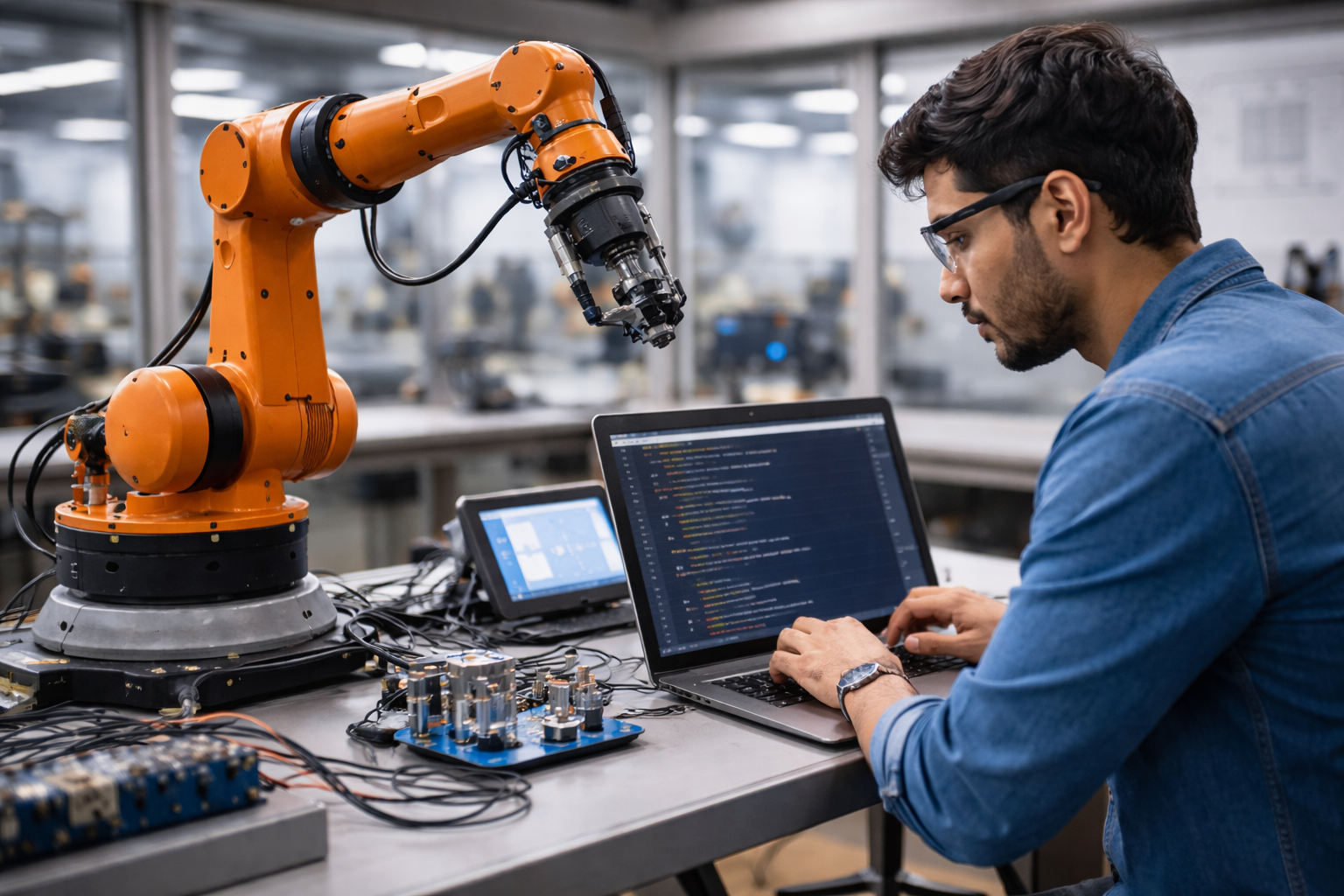
In universities, factories, and research labs, one question is coming up more often: does coding help with engineering or robotics in any way? As robots move beyond factory floors into healthcare, transport, energy, and consumer products, software has become a visible part of how machines are designed, tested, and operated. That shift is influencing how engineering degrees are structured and how employers think about skills.
The short answer, according to educators and industry analysts, is that coding now plays a supporting role across much of modern engineering, and a central role in robotics. It is rarely a replacement for mechanical or electrical knowledge, but it is increasingly a bridge that connects hardware to real-world use. This matters for students choosing a robotics engineering degree, for professionals in mechanical engineering robotics roles, and for employers weighing what skills they need as automation expands.
Coding’s growing importance also reflects wider economic trends. Investment in automation, artificial intelligence, and smart manufacturing has risen over the past decade, pushing companies to look for engineers who can work comfortably across disciplines. In that environment, programming is less about becoming a software developer and more about understanding how systems communicate, adapt, and respond to data.
Software and hardware are no longer separate worlds
Traditionally, engineering fields were more clearly divided. Mechanical engineers focused on structures, motion, and materials. Electrical engineers worked on circuits and power. Software development often sat elsewhere. Robotics changed that separation early on by combining mechanics, electronics, and control systems into a single product.
Today’s robots rely on code to interpret sensor data, control movement, and interact safely with people and other machines. Even simple industrial robots use software to follow paths, adjust speed, and detect faults. More advanced systems, such as autonomous vehicles or warehouse robots, depend heavily on programming to make decisions in real time.
That is why most robotics engineering courses now include some level of coding. Students may learn basic programming to control motors, read sensors, or simulate systems before building physical prototypes. In this context, coding helps engineers test ideas faster and reduce costly errors during manufacturing.
The same trend is visible in mechanical engineering robotics roles. Mechanical engineers working on robotic systems often need to understand how their designs will be controlled by software. They may not write large programs themselves, but reading code or adjusting parameters can help them diagnose problems or improve performance.
How coding fits into a robotics engineering degree
A robotics engineering degree typically blends mechanical design, electronics, control theory, and software. Coding is usually introduced early, often alongside mathematics and physics, because it supports later subjects rather than standing alone.
In practice, students use programming to model systems, run simulations, and control hardware. For example, code can be used to test how a robotic arm moves under different loads or how a mobile robot responds to obstacles. This approach allows students to explore “what if” scenarios without rebuilding physical components each time.
Robotics engineering courses also reflect how the industry works. Many projects are team-based, with students taking on different roles. One student may focus on mechanical design, another on electronics, and another on software integration. Understanding coding, even at a basic level, helps teams communicate more effectively and avoid design mismatches.
Educators say this cross-disciplinary exposure is one reason robotics graduates are attractive to employers. They may not be experts in every area, but they understand how different parts of a system depend on each other. Coding acts as a common language that links those parts together.
Education pathways and skills expectations
For students considering robotics engineering starting salary and education requirments, coding has become part of the baseline rather than a specialist add-on. Entry-level roles often expect graduates to be comfortable with at least one programming language used in engineering contexts, alongside core engineering knowledge.
This does not mean every robotics engineer spends most of their time writing software. In many jobs, coding supports tasks such as testing, calibration, data analysis, or automation of routine processes. Employers often describe it as a tool rather than the main product.
The emphasis on coding also reflects broader changes in engineering education. Universities are under pressure to show that graduates are “industry-ready,” and programming skills are often cited as evidence of practical training. This is similar to trends seen in other technical fields, where digital tools are now embedded in traditional disciplines.
From a policy and economic perspective, governments in the US, UK, and Europe have highlighted digital skills as a priority for future growth. Reports on automation and productivity often point to robotics and engineering as areas where software knowledge can raise efficiency. That context helps explain why coding appears more frequently in course outlines and job descriptions.
Pay and career implications
Discussions about robotics engineering starting salary and education requirments often focus on whether coding leads to higher pay. Analysts generally caution against simple conclusions. Salaries depend on location, industry, experience, and the type of role, not just on whether someone can code.
That said, employers frequently say that engineers who can work across hardware and software may have broader career options. They can move between roles more easily or take part in projects that involve system integration rather than narrow specialisation. Over time, that flexibility may influence career progression.
In mechanical engineering robotics positions, for example, familiarity with programming can help engineers move into systems engineering or project leadership roles. These positions often involve coordinating teams and understanding how design choices affect software behaviour and vice versa.
It is also worth noting that coding skills can age quickly if they are not used. Engineering fundamentals tend to be more stable over time, while programming tools and languages change. Many professionals therefore treat coding as a skill to maintain rather than a one-time qualification.
Global relevance and industry demand
The question of whether coding helps with engineering or robotics in any way is not limited to one country. In the US, automation has been a key part of manufacturing strategy as companies respond to labour shortages and supply chain pressures. In the UK, robotics and automation feature in discussions about productivity and industrial competitiveness. Similar debates are taking place across Europe and Asia.
Industry surveys often show strong demand for engineers who can support automation projects, especially in sectors such as logistics, energy, healthcare, and advanced manufacturing. Coding plays a role in all of these, whether through control systems, data analysis, or integration with digital platforms.
At the same time, analysts warn that demand can be cyclical. Investment in robotics may slow during economic downturns, affecting hiring. Understanding how skills fit into wider economic trends can help students and professionals make informed decisions. For example, shifts in trade policy and inflation can influence industrial investment, a topic discussed in broader economic reporting such as this analysis on tariffs and inflation pressures.
What to watch as robotics evolves
Looking ahead, the role of coding in engineering is likely to deepen rather than disappear. Advances in artificial intelligence and machine learning are adding new layers of software to robotic systems. Engineers may increasingly work with pre-built software frameworks rather than writing everything from scratch.
This does not reduce the need for engineering judgement. Instead, it shifts the balance toward understanding how software decisions affect physical performance and safety. Regulators and standards bodies are paying closer attention to this interaction, particularly where robots operate near people.
According to Reuters reporting, companies developing advanced robotics are placing more emphasis on testing, verification, and transparency in software-controlled systems. That trend suggests coding will remain closely tied to engineering responsibilities, even as tools become more user-friendly.
How coding supports engineering and robotics roles
| Area | How coding is used | Why it matters |
|---|---|---|
| Design and simulation | Modelling movement, loads, and control logic | Reduces errors before physical build |
| Control systems | Programming motors, sensors, and feedback loops | Enables precise and safe operation |
| Testing and diagnostics | Automating tests and analysing data | Speeds up troubleshooting |
| System integration | Linking hardware with software platforms | Improves reliability and scalability |
| Career flexibility | Supporting cross-disciplinary work | Broadens job options over time |
FAQ
Does coding help with engineering or robotics in any way if I focus on hardware?
Yes. Even hardware-focused engineers often use coding for simulation, testing, or system integration. It supports, rather than replaces, traditional engineering skills.
Is coding mandatory in a robotics engineering degree?
Most programmes include some programming because robots rely on software for control and sensing. The depth varies by course.
Do robotics engineering courses expect prior coding experience?
Many start at a beginner level, but basic familiarity can make the early stages easier.
How important is coding for mechanical engineering robotics roles?
It is usually supportive rather than central. Understanding code can help mechanical engineers work more effectively with software teams.
Does coding guarantee a higher robotics engineering starting salary?
No. Pay depends on many factors. Coding may widen opportunities, but it does not guarantee higher earnings.
Will coding skills become less important as tools improve?
Tools may become easier to use, but understanding how software affects physical systems is likely to remain important.
Conclusion
So, does coding help with engineering or robotics in any way? The evidence suggests it does, not as a standalone career path, but as a practical skill that connects design, control, and real-world performance. In robotics especially, coding has become part of the shared foundation that allows engineers from different backgrounds to work together. As automation continues to shape industries globally, that connection between software and engineering is likely to remain a defining feature of the field.