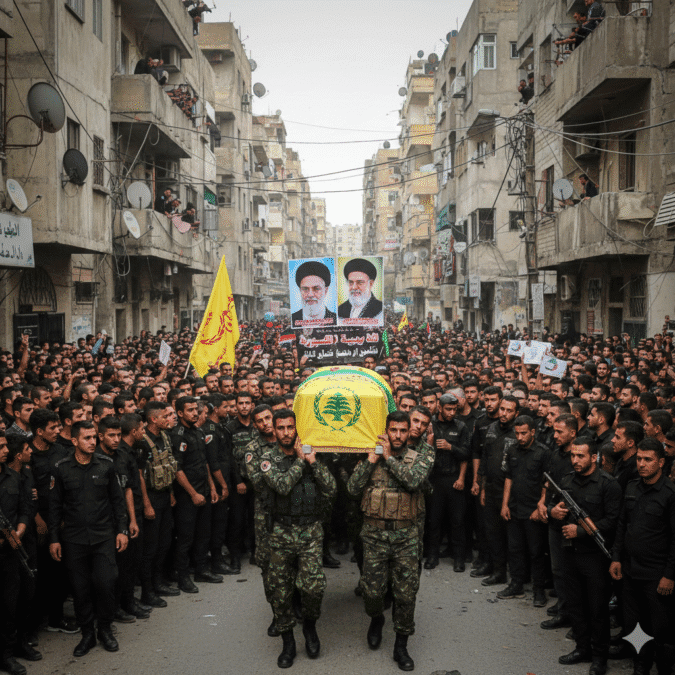
Hezbollah commander assassination, The air in the southern suburbs of Beirut was thick with grief and defiance on Monday as Hezbollah laid to rest its top military commander, Haytham Ali Tabatabai. The funeral procession, a somber yet potent display of the group’s resolve, was a direct response to the Israeli strike that killed him a day prior, marking the most significant blow to the Iran-backed group since a fragile ceasefire took hold over a year ago.
The assassination of Tabatabai, whom Israel identified as Hezbollah’s “chief of general staff,” is more than just another casualty in the long-standing shadow war between the two adversaries. It is a stark punctuation mark in a tense political standoff, one that threatens to unravel the precarious peace along the Lebanon-Israel border and tests the very sovereignty of the Lebanese state.
In the dense urban landscape of Dahieh, a Hezbollah stronghold, hundreds of mourners gathered. The scene was a familiar one for the group’s supporters: coffins draped in yellow flags, carried by uniformed fighters to the rhythm of religious chants. The crowd’s anger, however, was directed outward, with slogans against Israel and the United States filling the air. Portraits of Tabatabai were held aloft alongside those of Hezbollah’s leadership and Iran’s Supreme Leader, Ayatollah Ali Khamenei, a visual testament to the deep-seated alliances that define the conflict.
The killing strikes at the heart of Hezbollah’s post-war recovery. According to the group, Tabatabai had ascended to the role of military leader precisely to rebuild after the previous conflict had left them “heavily weakened.” His death demonstrates that despite the truce, Israel’s intelligence and strike capabilities remain potent, able to locate and target senior figures who believed themselves protected.
For Israel, the message was equally clear. Prime Minister Benjamin Netanyahu stated he would “not allow Hezbollah to rebuild its power,” explicitly urging the Lebanese government to “fulfil its commitment to disarm Hezbollah.” This demand places an immense burden on Beirut, which is caught between an assertive ally in Hezbollah and immense international pressure.
The path forward, outlined in the ceasefire agreement, requires Hezbollah to disarm north of the Litani River and for the Lebanese army to extend its authority. Yet, this plan appears to be faltering. A Lebanese military official recently confessed that meeting the year-end deadline for disarmament is “impossible,” citing a lack of personnel and equipment and fearing violent clashes with Hezbollah’s widespread support base.
Within Hezbollah, the dilemma is acute. A source within the group revealed a division between those calling for immediate retaliation and a leadership inclined toward “utmost forms of diplomacy.” As Nicholas Blanford, a researcher at the Atlantic Council, noted, “Hezbollah’s options are very limited.” Any significant response could provoke a devastating Israeli counterstrike, for which, he warns, “no one in Lebanon will thank Hezbollah.”
Amid this tense calculus, Hezbollah’s public face remains one of staunch defiance. Senior official Ali Damush told mourners that the assassination aimed to force Hezbollah into “surrendering, and submitting, but this goal will never be achieved.” He warned that Israel “should remain worried” about a potential response.
Meanwhile, Lebanon’s civilian government is left navigating an impossible situation. Prime Minister Nawaf Salam condemned the strike but reiterated that the only sustainable solution lies in “extending the authority of the state over all its territory.” It is a noble goal, but one that seems increasingly distant as the drums of war grow louder and the grave of a top commander fresh. The silence after the funeral chants fade will be the most telling, as a nation, and a region, waits to see if this provocation tips the scale back toward war.