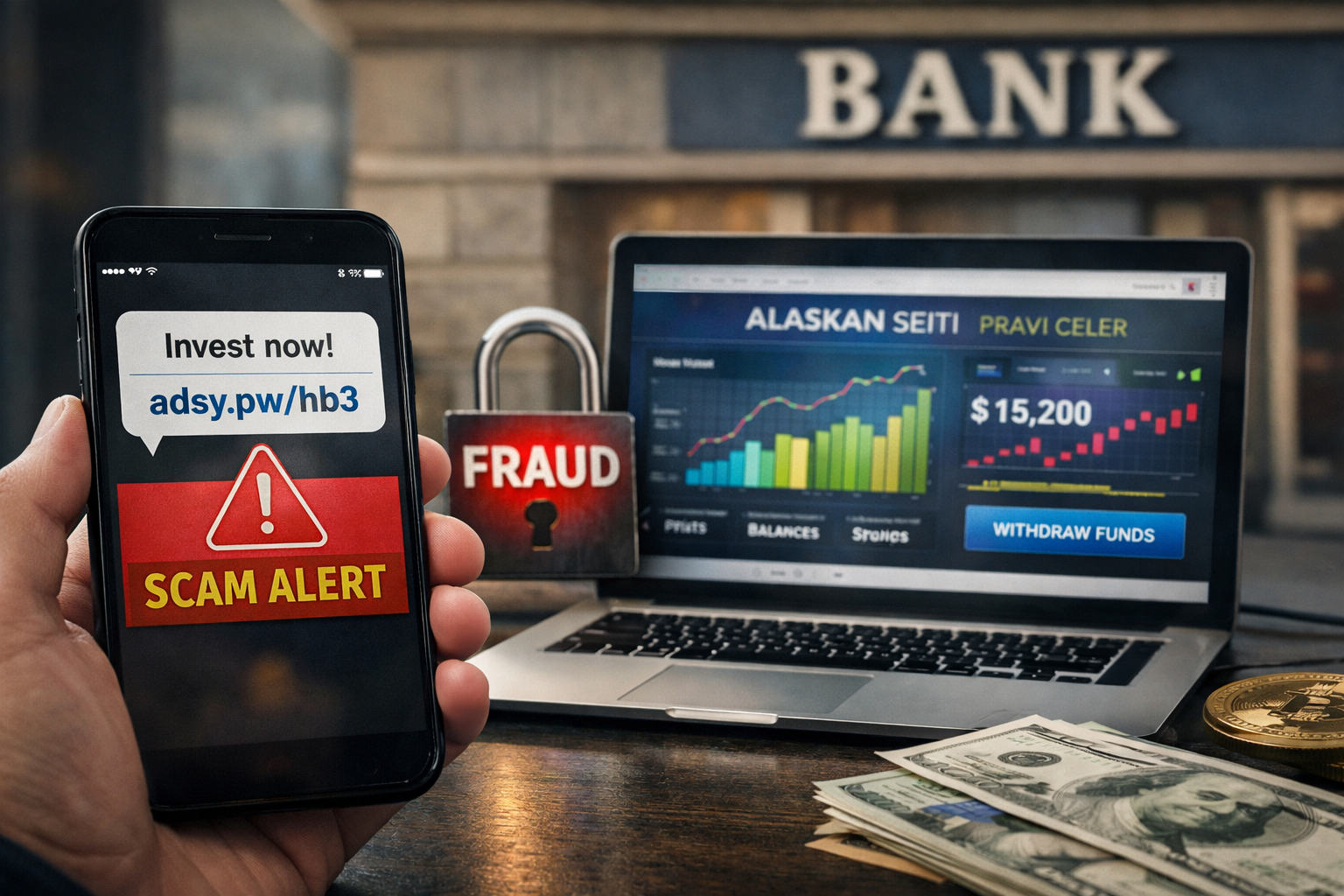
A new wave of investment scam links is moving through social media, messaging apps, and search ads, pushing fraud from the margins into the mainstream of consumer finance. Regulators and law enforcement agencies say the schemes increasingly look like legitimate investing complete with professional websites, “customer support,” and dashboards that show supposed profits until victims try to withdraw money and discover the platform was never real.
The rise is showing up in official data. In the United States, the FBI’s Internet Crime Complaint Center said reported losses across cyber and online crime exceeded $16 billion in 2024, up sharply from the previous year. In the same period, the Federal Trade Commission said investment scams generated some of the largest reported losses in the fraud categories it tracks.
In Britain, the Financial Conduct Authority has repeatedly warned about investment fraud and “clone firms,” in which criminals impersonate authorised institutions by copying names, addresses, or reference numbers to gain trust. The FCA has also urged banks and payment firms to strengthen how they detect and interrupt scams that can begin with a simple message and end with transfers that are difficult to reverse.
What is changing is not only the scale of fraud but the mechanics of how it spreads. Investigators and consumer advocates say fraudsters are leaning on the same digital distribution tools used by legitimate businesses: targeted advertising, influencer-style content, and frictionless payment rails. A link, a click, and a convincing landing page can turn a casual scroll into a financial loss.
From “too-good-to-be-true” pitches to professional-looking platforms
The modern investment scam often begins with a referral sometimes from an online ad, sometimes from an unsolicited message, and sometimes through a relationship built over time. UK and US authorities have warned that romance-linked fraud can be a gateway into investment cons, particularly when a scammer cultivates trust before introducing a “can’t-miss” opportunity.
Once the hook is set, the pitch typically points to an external site or app download. The link itself can be deliberately opaque. Shortened URLs can hide the true destination, and victims may not notice subtle changes in spelling or domain endings. The FBI has warned that criminals also build fake versions of trusted portals by changing small details in web addresses to harvest personal information.
Fraud teams say the branding can be intentionally confusing a jumble of words meant to sound technical without being easy to verify. In some cases, scam materials may include odd labels that look like internal project names or “platform identifiers,” such as alaskan seiti, eo pis, or pravi celer, presented as if they were regulated products or proprietary strategies. The purpose is not clarity but momentum: keep a target moving forward before questions slow the process down.
Links can also be designed to avoid automated filters. To reduce the risk of amplifying potentially harmful URLs, consumer groups often redact examples when they publish them. A shortened path written as adsy[.]pw/hb3 can illustrate the pattern a compact address that reveals little about where it leads without promoting a live, clickable link.
For victims, the early stages can feel like normal investing. They may see charts, balances, and trade confirmations. Some platforms show small “withdrawals” at first to build confidence. But when larger sums are involved, requests to withdraw can trigger delays, new fees, identity checks, or demands for additional deposits.
US regulators have described how investment scams can generate high losses and high conversion rates once a target has been persuaded. In FTC data for 2024, investment-related scams stood out for large reported losses, and the agency said a majority of people who reported an investment scam also reported losing money.
Why banks, brokers, and payment networks are paying attention
The financial system is not the only victim in these schemes, but it is often the route the money takes. That puts banks, payment providers, and trading platforms in the spotlight and exposes them to reputational risk, customer complaints, and rising compliance costs.
One reason is that scam payments can move quickly. Bank transfers, card payments, and crypto rails each offer different advantages to criminals. The FTC has highlighted that bank transfers and crypto transactions feature prominently in reported fraud losses, reflecting both consumer habits and the difficulty of recovering funds once they are sent.
In the crypto world, industry researchers say “pig butchering” and related investment fraud models have become more industrialised, using scripted outreach, customer-service style chat, and laundering pathways that can span multiple wallets and exchanges. Chainalysis estimated that cryptocurrency scams received billions in 2024, noting that the total can rise as more illicit addresses are identified.
Law enforcement agencies say the fraud economy is also global. The FBI has urged victims of cryptocurrency investment fraud to report incidents quickly, underscoring how cross-border elements can complicate recovery.
For markets, the issue is not only consumer harm. Analysts who track financial crime say large-scale fraud can distort the flow of funds in ways that affect payment volumes, trigger tighter controls that raise friction for legitimate transactions, and increase pressure on platforms that profit from rapid account onboarding.
Banks and fintech firms are responding with more behavioural analytics, stricter checks on new payees, and expanded warnings at the point of payment. In the UK, the FCA has argued that interrupting scams can require active steps from banks to “break the spell” in emotionally charged schemes, including romance-linked cases that escalate into financial loss.
Meanwhile, the FCA’s long-running warnings on clone firms show how impersonation can sit at the centre of investment fraud. Clone operators may copy the details of real firms and use that borrowed credibility to push fake products. In earlier public warnings, the FCA has pointed to significant reported losses tied to investment scams, illustrating the financial scale that can follow from a convincing façade.
What regulators are likely to watch next
Regulators on both sides of the Atlantic are balancing two goals: keeping payments fast and accessible while preventing fraud from exploiting the same speed. That tension is likely to intensify in 2026 as more financial activity shifts to mobile-first channels and as artificial intelligence lowers the cost of creating realistic content.
Authorities are also signalling that scam prevention is becoming a shared responsibility across the chain from the ad ecosystem that distributes promotions, to the messaging services where pitches circulate, to the banks and exchanges where money moves.
In the United States, the FBI’s annual reporting has become a focal point for policymakers and industry teams trying to understand where losses concentrate and how criminals adapt. In Britain, the FCA continues to direct consumers toward its register and warning list tools and to highlight how impersonation can defeat basic trust checks if users rely only on a name or a logo.
One emerging challenge is the “second-stage” scam: criminals who target victims again, offering recovery services or legal help for a fee, or impersonating official portals. The FBI has warned about fake versions of its own crime-reporting resources, a sign that fraud can extend beyond the initial loss into identity theft and account compromise.
For firms, the next phase may include greater scrutiny of how quickly they respond to scam signals and how they coordinate with peers. Industry groups have promoted campaigns focused on relationship-investment scams, reflecting concern that many victims do not recognise the fraud until it is too late.
The broader market implication is that fraud is no longer a niche operational issue. As reported losses rise, regulators and lawmakers may push for tougher standards on onboarding, advertising practices, and payment verification steps that could increase costs and slow some customer journeys, even as they aim to reduce harm.
For consumers, the shift is simpler: the look and feel of fraud is converging with the look and feel of legitimate finance. That makes the original trigger the link more important than ever. A single tap on an “investment opportunity” can open a pathway to data theft, unauthorised transfers, or a long dispute over funds that may be impossible to recover.
Table
| What people may see | Why it can be convincing | Why institutions care |
|---|---|---|
| A professional website or app with charts and balances | It resembles a real brokerage dashboard | It increases complaint volumes and reputational damage when losses occur |
| A shortened or unclear URL (e.g., written as adsy[.]pw/hb3) | It hides the true destination and looks “normal” in messages | It can bypass basic filters and accelerate click-through rates |
| Names that sound technical but are hard to verify (e.g., alaskan seiti, eo pis, pravi celer) | It creates the impression of proprietary tools or products | It makes due diligence harder and complicates customer support investigations |
| Early “returns” shown on-screen | It builds trust and encourages larger deposits | It increases the size of eventual losses and the urgency of disputes |
| Pressure to act quickly or keep the offer private | It reduces time for verification and second opinions | It raises the likelihood of irreversible payment methods being used |
FAQ
Q1: What does “clone firm” mean in the UK context?
A clone firm is a scam operation that impersonates a legitimate authorised firm, often copying names, addresses, or reference details to appear genuine.
Q2: Why do investment scams often use shortened links?
Shortened links can hide the final destination and make it harder to spot suspicious domains or subtle spelling changes, which can increase the chance someone clicks through.
Q3: Are investment scams mostly a crypto problem?
No. Crypto is a common channel in some schemes, but investment scams also use bank transfers and other payment methods; regulators track losses across multiple rails.
Q4: What’s “pig butchering” in fraud reporting?
It typically refers to schemes where criminals build trust over time sometimes via romance or friendship before introducing a fake investment platform and encouraging larger deposits.
Q5: Why do authorities encourage reporting even if money is gone?
Reports help investigators identify patterns, trace funds where possible, and warn other potential victims. The FBI and UK reporting channels emphasise reporting for this reason.