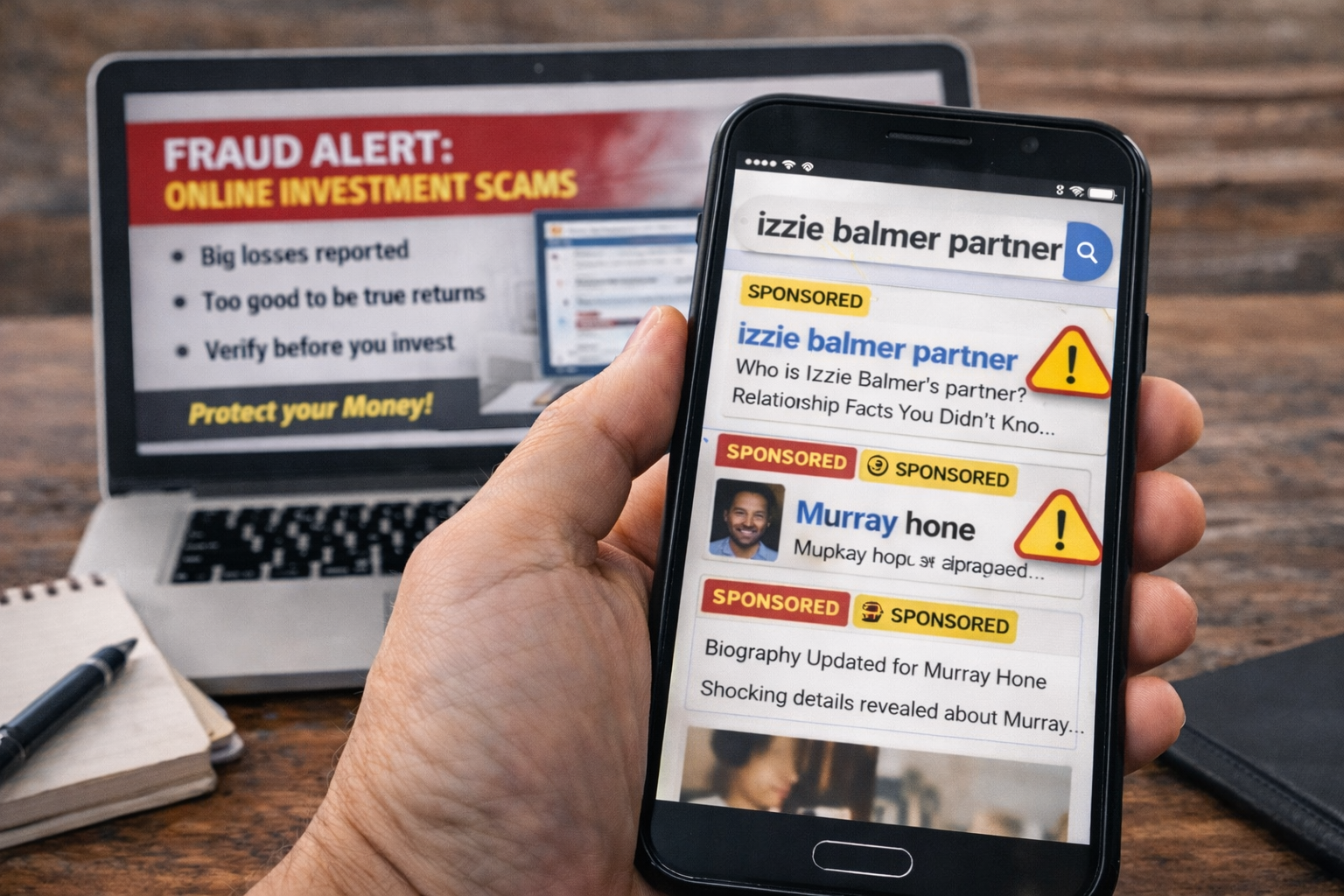
The query “izzie balmer partner” looks like simple curiosity. So does typing “murray hone” into a search bar after seeing the name mentioned on a blog, in a comment thread, or in a suggested search box. But to the internet’s ad economy, those two phrases are not just curiosity. They are inventory high-intent keywords that can be packaged into traffic, sold through ads, and monetised at scale.
The problem is that name-based searches are also among the easiest to exploit. They sit at the intersection of personal interest and low-friction clicking, where a user wants a quick answer and platforms want quick engagement. That can create ideal conditions for thin content, false certainty, and, at the worst end, scam funnels that begin with a search result and end with a payment.
The broader backdrop is not subtle. The FBI’s Internet Crime Complaint Center (IC3) said its 2024 annual report detailed reported losses exceeding $16 billion, with record reported losses of $16.6 billion in the PDF report. The US Federal Trade Commission, using 2024 consumer reports, said investment scams produced the largest reported losses among fraud categories $5.7 billion while overall reported fraud losses reached $12.5 billion.
Those figures are not driven by celebrity searches alone. But fraud analysts say many scams start with the same digital mechanics as advertising: attention capture, trust signals, and a pathway that nudges users toward action before they verify what they are seeing.
Curiosity becomes commerce
Izzie Balmer is a real public figure: an English auctioneer and antiques television presenter, known for BBC daytime programmes such as Antiques Road Trip and Bargain Hunt, according to widely available biographies. As her on-screen profile has grown, searches about her personal life have followed. That pattern is common across media: public interest in someone’s work often spills into interest in their private life.
Yet the key point for readers is what can be verified. Major reference-style profiles that describe her career do not reliably confirm details about a current partner. Lifestyle coverage may focus more on professional relationships with co-stars and colleagues than on a confirmed partner.
That “information gap” is exactly what the keyword economy monetises. When a query is popular but the underlying facts are limited or private, the web fills the space anyway often with pages designed primarily to rank and to earn ad revenue. Some of those pages are harmless; they summarise public information and openly note what is unknown. Others are more aggressive, implying certainty without evidence or mixing unrelated names into the story to catch additional searches.
That is where murray hone often appears in the broader internet ecosystem: not because reputable sources connect him to Izzie Balmer, but because his name is already indexed in celebrity-adjacent content elsewhere, making it a useful “extra hook” for low-quality pages.
Why “Murray Hone” is a perfect example of search confusion
The term murray hone illustrates another problem with name-based keywords: identity collisions. A single name can refer to multiple people, and search engines will show a blended set of results unless the user adds context.
There is at least one Murray Hone who is publicly documented as the former spouse of actress Evangeline Lilly. Wikipedia and IMDb list Lilly as having been married to hockey player Murray Hone from 2003 to 2004.
At the same time, searches can surface other “Murray Hone” profiles that appear unrelated, including a Canadian business professional profile on LinkedIn. This does not mean one profile is “wrong.” It means the keyword is broad, and search results can combine different identities into one confusing stream.
For publishers chasing traffic, that confusion can be profitable. A page can mention “Murray Hone” in a way that attracts users who are searching for the hockey player, the business executive, or simply “who is this?” and then pair it with other trending name-queries, such as “izzie balmer partner,” to widen the funnel.
For users, the cost is time and trust. For platforms, the cost can be reputational and financial: mixed identities and shaky claims can lead to complaints, reports, and a constant moderation burden.
The finance angle: ads, affiliates, and the scam pathway
To understand why this is a finance story, it helps to follow the money trail.
Search queries like “izzie balmer partner” can trigger sponsored results and ad placements. Those placements can send traffic to publishers running display ads, affiliate links, or lead-generation forms. Most of the time, the worst outcome is wasted time. But in a smaller share of cases, the funnel can pivot into something more harmful: fake giveaways, “verification” pages that collect personal details, or investment pitches that use celebrity-style credibility cues.
Regulators have warned that fraudsters often build false relationships or trust narratives online to push people toward payments. In the UK, the Financial Conduct Authority said romance fraud frequently starts online and urged banks and payment firms to help disrupt it—what it described as helping to “break the spell.” The connection to “partner” searches is straightforward: when people are primed to think in terms of relationships, it can be easier for bad actors to steer conversations toward trust, urgency, and money.
None of this implies that fans searching “izzie balmer partner” are about to be scammed. It implies something narrower: the same systems that monetise celebrity curiosity at scale can also be used at the margins for deception, because they reward clicks and speed more than verification.
The FTC’s latest fraud data underscores why the incentives matter. It said consumers reported losing more to investment scams than any other category in 2024, and noted that losses tied to bank transfers and cryptocurrency were especially prominent in reports. That is the “end of the funnel” risk: once money is sent via certain rails, recovery can be difficult.
Table
| Keyword | What a user is usually trying to learn | What can be verified from stronger sources | Where the monetisation pressure shows up | Main risk if results are low-quality |
|---|---|---|---|---|
| izzie balmer partner | Whether Izzie Balmer has a confirmed partner | Career and profile details are widely documented; partner details are not consistently confirmed in reference-style profiles | Sponsored results, clickbait pages, “relationship” explainers | False certainty, misattribution, data-harvesting “quiz” pages |
| murray hone | Who he is, and why the name appears in celebrity content | Evangeline Lilly’s spouse history includes Murray Hone (2003–2004) | Identity-collision content, SEO pages mixing multiple people | Confusion between individuals; incorrect linking to unrelated celebrities |
What to watch next
Platforms are under pressure to reduce harm without shutting down legitimate publishing. That often means stronger enforcement against impersonation, deceptive redirects, and pages that collect data under misleading pretences. But name-based queries will remain a challenge because they are inherently messy: people search with incomplete context, and the web is eager to supply answers whether or not the facts exist.
A second watchpoint is how financial institutions respond to scam patterns that start outside the banking system. When fraud begins on social media or through search ads, the bank often sees it only when a payment is initiated. UK regulators have pushed firms to improve detection and intervention, especially in romance-style scams that can involve repeated payments over time.
The third watchpoint is consumer fatigue. As reported losses stay high, users may become more sceptical, and scepticism can change ad performance. That can reduce returns for low-quality publishers and increase demand for trusted, verifiable sources an incentive shift that platforms and advertisers are watching closely.
FAQ
Q1: Is there confirmed public information about “izzie balmer partner”?
Reliable reference-style profiles focus on her career and do not consistently confirm a current partner.
Q2: Who is Murray Hone?
“Murray Hone” can refer to different people online. One widely cited public reference is Murray Hone as Evangeline Lilly’s former spouse (married 2003–2004).
Q3: Are “izzie balmer partner” and “murray hone” connected?
I did not find reputable, verifiable sources linking Murray Hone to Izzie Balmer. The pairing often appears to reflect SEO and keyword mixing rather than confirmed reporting.
Q4: Why is this a finance topic?
Because the keyword economy monetises clicks through ads and affiliates, and misleading funnels can escalate into fraud. US agencies report very large annual losses linked to online crime and scams.
Conclusion
The keywords “izzie balmer partner” and “murray hone” show how modern search turns curiosity into a marketplace: traffic is bought, pages compete to rank, and low-quality content can fill gaps where facts are limited or private. The financial risk is not in the names themselves, but in the incentives around them where speed and clicks often win over verification, and where a small share of misleading funnels can spill into real-world losses, disputes, and erosion of trust.