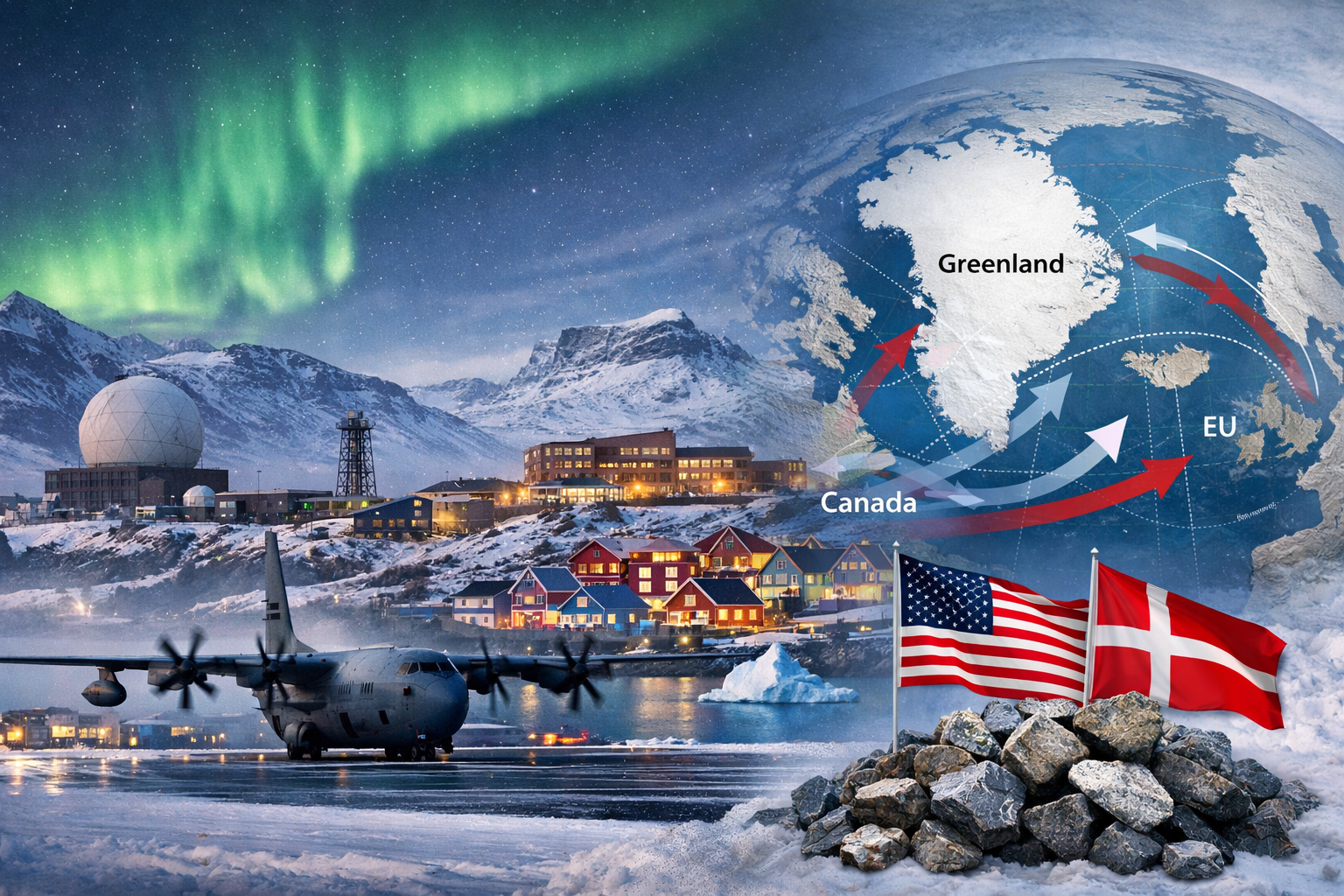
The jd vance greenland dispute is no longer just a diplomatic story. It is also starting to matter for investors who track defence spending, critical minerals, and the cost of doing business across the North Atlantic.
U.S. Vice President J.D. Vance visited the U.S. military base at Pituffik in northern Greenland in late March 2025 and criticised Denmark’s handling of security on the island, while President Donald Trump continued to press the idea that the United States should control the territory.
Denmark and Greenland pushed back sharply, with Denmark’s prime minister calling the pressure “unacceptable” ahead of the original visit plan, which was later scaled back so the trip focused on the base. The episode landed at a sensitive time for Greenland’s politics, with parties announcing a broad coalition government as the external attention intensified.
For markets, the key point is not a single speech at a remote base. It is the bigger direction of travel: rising Arctic competition, louder debate inside NATO about burden-sharing, and fresh focus on Greenland’s resources and infrastructure. That combination can shape defence budgets, commodity projects, and transport links over years, even if day-to-day diplomacy remains messy.
As New York Times reporting around the visit showed, the story mixes strategy, symbolism and local politics. Investors tend to translate that into simpler questions: who pays for security, who controls supply chains, and what rules will apply to new projects.
A strategic island with a small economy
Greenland is an autonomous territory within the Kingdom of Denmark. It has its own government in Nuuk, while Denmark handles areas like defence and foreign policy in cooperation with Greenlandic authorities. Greenland’s economy is small, and fishing has long dominated exports, while policymakers have looked to expand tourism and mining over time.
The island is also central to Arctic geography. It sits along routes that matter for air and sea movement between North America and Europe. It hosts U.S. military infrastructure that Washington views as important for Arctic awareness and, more broadly, national security.
That mix strategic value paired with a limited local tax base creates a recurring tension. When major powers argue about security in Greenland, the debate quickly turns to money: defence assets, surveillance systems, ports, airports, and the supply lines needed to support them.
Even tourism and air travel have become part of the story. Greenland opened a new international airport in Nuuk, and Reuters reported that tourism interest picked up as Trump’s comments drew global attention. That matters because visitor flows can change the economics of hotels, services, local air routes, and public infrastructure planning.
In practical terms, many travellers still start with denmark greenland flights, because Copenhagen is a key hub for reaching the island. Air Greenland describes services from Copenhagen to Nuuk, including routings that can involve Kangerlussuaq depending on schedules and operations. The detail may sound niche, but it shows how Greenland’s connectivity is often shaped by a small number of routes and operators something investors watch when they assess whether a mining or tourism project is “realistic” rather than just “interesting”.
What investors are watching: defence, minerals, and supply chains
Vance said the United States had no immediate plans to expand its military footprint on the ground, but he spoke about investing in capabilities such as naval ships and resources linked to Arctic security. Even without a near-term base expansion, the direction suggests a policy preference: more Arctic capacity, more monitoring, and more spending where Washington believes gaps exist.
That can matter for listed defence firms, shipbuilding supply chains, and companies tied to surveillance, communications, and satellite-related services. It can also influence European policy. When U.S. leaders publicly criticise European allies, those allies often respond by highlighting their own investments or by accelerating them to show credibility.
At the same time, Greenland is repeatedly discussed as a place with valuable mineral potential, including rare earth minerals. Rare earths are a group of metals used in magnets and components found in products like electric motors, wind turbines, and some defence systems. But mining is slow, capital-intensive, and politically sensitive, especially in fragile environments.
This is where markets can misread the story. A political statement can move attention faster than the real economy can move equipment. Greenland’s projects face basic constraints: weather, limited roads between towns, and high logistics costs. Even within the island, travel between communities often relies on aircraft and ships.
That is why even simple background questions matter in finance coverage. People looking up cities in greenland are not just doing travel homework. They are also learning where workers live, where ports exist, and which towns might realistically support new industrial activity. Travel and tourism sources often highlight larger towns such as Nuuk, Ilulissat, Sisimiut and Qaqortoq as key places people move through.
And if someone searches “cap city of greenland,” the answer is Nuuk Greenland’s administrative and economic centre. For investors, “capital” is not just a trivia item. It is where permitting decisions, local politics, and public procurement debates are concentrated.
Timeline table: key moments around the March 2025 visit
| Date (2025) | What happened | Why markets noticed |
|---|---|---|
| Mar 21 | Reuters reported tourism interest rising alongside attention to a new international airport in Nuuk, with plans for more connectivity. | Infrastructure can change the economics of tourism and long-term projects. |
| Mar 23–25 | Reuters described plans for a high-profile U.S. delegation and Denmark’s pushback, calling the pressure “unacceptable.” | Tension inside alliances can affect defence planning and trade tone. |
| Mar 26 | Reuters reported the visit was narrowed to a military base after the diplomatic spat. | Showed sensitivity in Greenland and Denmark to symbolism and optics. |
| Mar 28 | Reuters reported Greenland parties forming a broad coalition amid external pressure. | Local politics shape the rules for mining, tourism, and foreign engagement. |
| Mar 28–29 | Reuters reported Vance’s visit to Pituffik, criticism of Denmark’s security approach, and talk of investment in Arctic resources. | Defence supply chains and Arctic policy became more investable themes. |
| Apr 2 | Reuters reported Denmark’s prime minister would visit Greenland after the frosty reception to Vance’s trip. | Suggested the issue would remain active in Nordic politics and NATO discussions. |
How this connects to broader macro risks
The Greenland episode sits inside a wider set of market concerns: defence rearmament, supply-chain “de-risking”, and political pressure that can spill into trade.
When big geopolitical arguments escalate, markets often look for second-order effects: sanctions risk, new controls on technology, or tariffs that hit growth and inflation. In that sense, Greenland is part of the same broader story investors have been watching in recent years how politics can reshape prices and policy.
That is one reason this story also travels with other headlines about trade and inflation. If you are tracking how tariff debates can feed into consumer prices and policy expectations, this related background on tariffs and inflation helps frame why markets react strongly when politics turns into policy.
Still, it is important not to overstate the near-term market impact. There is no single “Greenland trade” that moves global indices overnight. The bigger influence tends to be gradual: shifting defence budgets, changing investor interest in Arctic infrastructure, and evolving rules around strategic minerals.
What to watch next
One key watchpoint is whether Greenland and Denmark pursue more formal Arctic security arrangements inside NATO, or whether the debate stays mostly rhetorical. Another is whether the U.S. links Greenland more directly to procurement decisions ships, monitoring systems, and Arctic-capable platforms.
A second watchpoint is the pace of Greenland’s infrastructure build-out. Reuters has reported plans for more international airport capacity beyond Nuuk, including Ilulissat and Qaqortoq in the coming period. If connectivity improves and remains reliable, that can lower the cost of moving people and equipment, which matters for both tourism and industry.
A third is the political balance inside Greenland itself. A broad coalition can signal stability, but it can also mean complex compromises on sensitive issues like mining and foreign involvement. In small economies, politics can change the investment outlook quickly because a limited number of projects account for a large share of future growth hopes.
Finally, there is a small but real source of confusion that shows up in search data and travel planning: “greenland nh” is also a place Greenland, New Hampshire in the United States. It has nothing to do with Arctic security, but the overlap is a reminder that headlines can drive sudden public interest, and that interest often shows up first in searches and bookings sometimes messy, sometimes misdirected, but still measurable.
For investors, that is the core lesson. Greenland is not a large economy, but it can be a large signal: about where security spending is heading, how alliances are working under stress, and how supply chains for strategic materials could be shaped by politics as much as by geology.
FAQ
1) Why does the jd vance greenland visit matter to markets?
Because it highlights Arctic security priorities and alliance tensions, which can influence defence spending, infrastructure plans, and long-term supply-chain strategy.
2) What is the capital city of Greenland?
Nuuk is Greenland’s capital and its main administrative centre.
3) Are there regular Denmark–Greenland flights?
Yes. Air links typically run between Copenhagen and Nuuk, and schedules may involve other airports depending on season and operations.
4) Is Greenland rich in critical minerals?
It is often discussed as having mineral potential, including rare earths, but projects depend on economics, logistics, environmental rules, and politics.
5) What does “greenland nh” refer to?
It commonly refers to Greenland, New Hampshire, a town in the United States, not the Arctic island.
Conclusion
The JD Vance Greenland trip underlined how a remote Arctic territory can sit at the centre of much larger questions about alliance politics, defence funding, and control of strategic routes and resources. In the near term, the diplomatic fallout may matter more than any immediate economic shift, because Greenland’s small scale and harsh logistics limit how fast projects can move. Over the longer run, the bigger market signal is whether the United States, Denmark and Greenland translate this moment into concrete decisions on Arctic capability, infrastructure such as airports and ports, and the rules that shape mining and foreign involvement.