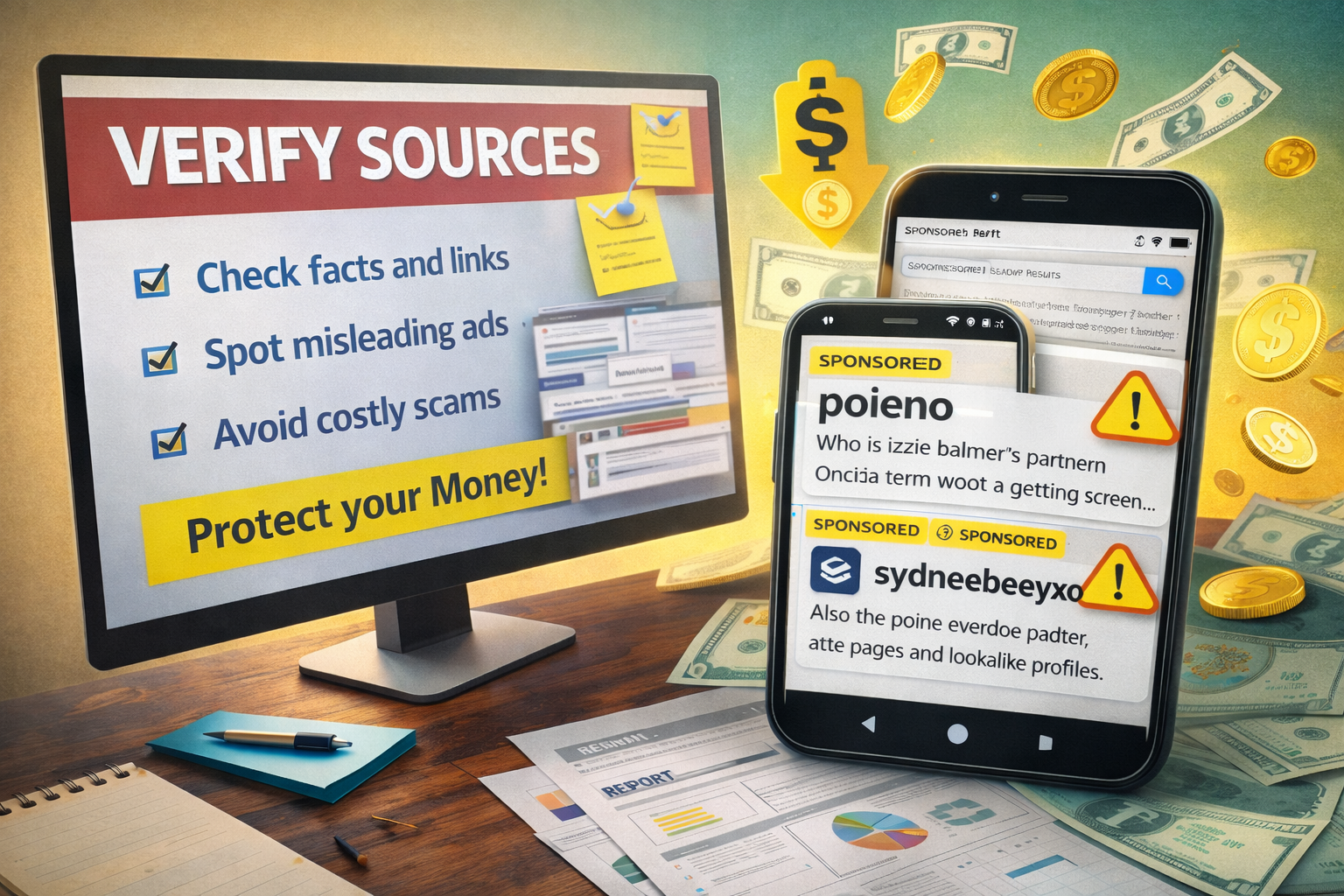
Typing poieno into a search bar can feel like stumbling into a new trend. The word looks “brandable,” short enough to fit in a logo, and unusual enough to spark curiosity. Search sydneebeeyxo and the experience can be even more fragmented: a handle-like term that points to scattered profiles and third-party pages trying to explain who or what it is.
That split is becoming a recognisable pattern in digital markets. A keyword does not need a clear definition to become financially important. It just needs attention. When attention concentrates, advertising bids follow, affiliate funnels appear, and “explainer” pages multiply. The result is a small but real market where monetisation often moves faster than verification.
The risk is not that every niche keyword hides a scam. It is that unclear terms create ideal conditions for low-quality content and opportunistic marketing, and those conditions can sit in the same distribution channels used by fraud. US agencies have repeatedly highlighted the scale of online harm: the FBI’s Internet Crime Complaint Center said reported losses exceeded $16 billion in 2024. The US Federal Trade Commission has also reported that investment scams are among the categories associated with the largest losses reported by consumers.
Poieno: a word with momentum, not a fixed meaning
A key issue with poieno is that it is being written about as if it has a settled origin, even though it is not widely documented in standard dictionaries or reference works. Instead, much of what appears in search results comes from recent “meaning” articles and SEO-style explainers.
Many of those pages suggest poieno is connected to creation or openness, sometimes claiming links to Greek and Romanian roots. Those claims are difficult to verify as claims about the word “poieno” itself, but the underlying linguistic references they borrow from are real.
For example, the Romanian noun poiană (plural poiene) is defined as a “clearing” or “glade” in Romanian language references. And the Ancient Greek verb ποιέω / ποιεῖν is tied to the idea of “making” or “creating,” as shown in Greek lexical references.
That matters because it shows how modern keyword trends are often assembled. A new term can gain credibility by “sounding” like it has classical roots, even when the word itself is new, repurposed, or simply being promoted into existence by repetition. In practice, a word like poieno can become a container: people and pages pour meaning into it because the ambiguity makes it flexible for branding.
From a finance perspective, flexibility is commercial fuel. If poieno can be presented as a concept, a project name, an aesthetic label, or a lifestyle “framework,” then multiple publishers can compete to rank for it. That competition is monetisable through ads, affiliate links, and lead capture. It can also become a domain strategy: a new name can be tested quickly as a website, then pivoted if the traffic appears.
In search results, that “test” phase is visible. Several recently published pages treat poieno as a rising concept across culture and digital identity, with inconsistent stories about what it is and where it comes from. A reader is not being shown a stable definition; they are being shown a marketplace of interpretations.
Sydneebeeyxo: the handle as a micro-brand
If poieno illustrates how a word can be promoted into relevance, sydneebeeyxo shows how a handle can behave like a brand even when the identity behind it is unclear.
One verifiable anchor is that “Sydneebeeyxo” exists as a Reddit user profile that is flagged as NSFW (adult content). Beyond that, the term appears across third-party write-ups that describe it as an online persona or influencer identity, but those pages are largely promotional or generic and should not be treated as authoritative reporting.
There are also variant handles that look similar, such as an Instagram account using a related “SydneeYXO” style name, showing that close variants of the term are used on mainstream platforms, even if they are not the exact same account. The practical effect for users is confusion: a search for “sydneebeeyxo” can produce a blend of different identities, mirrors, and explainers.
In digital advertising and affiliate markets, that kind of confusion has a price. Handles and name-like keywords can be bid on in ad auctions, used as bait in click funnels, or scraped into auto-generated pages designed to capture branded queries. When the underlying identity is not clearly verified, it becomes easier for impersonators and low-quality publishers to fill the gap.
That does not automatically imply criminal behaviour. It is simply how the incentive system works. A person searching for a handle often wants a fast path to the “real” profile. Fast intent is valuable intent. Valuable intent attracts intermediaries.
Where the money moves, and where the risk accumulates
The poieno sydneebeeyxo pairing is a useful lens because it highlights two different inputs into the same machine.
Poieno behaves like a “concept keyword.” It invites explainers, definitions, and aesthetic framing. Sydneebeeyxo behaves like a “brand query.” It invites profile hunting, identity matching, and social links. Both produce monetisable traffic, and both can be exploited when the result set is crowded with low-quality pages.
The chain typically looks ordinary, even when the end result is not. A user searches a term. They click a result. The page loads ads. The page suggests another click, sometimes toward a “download,” a “profile,” a “verification,” or a “full details” page. Every step can pay someone: the platform, the publisher, and sometimes an affiliate partner.
Most of the time, that is merely annoying. But the same mechanics also sit adjacent to scam pathways. When a funnel pivots into financial solicitation whether a fake investment pitch, a “membership,” a paid link, or a request for personal datathe losses can become real. That broader context is why regulators keep emphasising the scale of online harm and the need for verification in high-risk channels.
The market implication is that keyword integrity is becoming a cost centre. Platforms invest more in moderation. Advertisers invest more in brand safety. Payment providers invest more in fraud detection. Those costs are not always visible in the keyword itself, but they show up in disputes, enforcement actions, and the gradual tightening of ad rules.
Table
| Keyword | What is relatively verifiable | What is often unclear or easily manipulated | Why it matters financially |
|---|---|---|---|
| poieno | The Romanian word poiană/poiene means a clearing or glade; Ancient Greek ποιεῖν/ποιέω relates to making/creating. | Whether “poieno” itself has an established definition; many explainers are recent and inconsistent. | Ambiguity enables SEO arbitrage and rapid ad monetisation without a stable source of truth |
| sydneebeeyxo | Exists as a Reddit profile and is flagged NSFW. | Whether search results point to one identity or multiple lookalikes; many third-party write-ups are generic. | Handle confusion can amplify impersonation risk, misleading redirects, and payment disputes |
FAQ
What is poieno, in plain terms?
Online, poieno is being used as an emerging keyword with inconsistent meanings. Some writers link it to “creation” or “clearing” ideas inspired by Greek and Romanian roots, but the word itself is not widely established in standard references.
Is sydneebeeyxo a person, brand, or something else?
It functions like a handle-based identity term online. One verifiable anchor is a Reddit user profile under that name, flagged NSFW, while many other pages describing it are not authoritative.
Why do unclear keywords matter in finance?
Because unclear keywords can still drive high-intent traffic, which attracts ads and affiliate funnels. That creates operational costs moderation, disputes, and fraud screening—especially when misleading pages appear in search pathways.
Does this mean these terms are scams?
No. It means the incentive system around trending or ambiguous keywords can reward low-quality or misleading behaviour, which is why platforms and regulators focus on verification and consumer protection in high-risk channels.
Conclusion
Poieno and sydneebeeyxo show how online attention can become a tradable asset even when meaning is unclear. Once a term starts getting searched, ads, affiliate pages and lookalike profiles can move in fast, because the money is in the click not the certainty. The result is a market where verification often lags behind momentum, increasing the chances of confusion, misinformation, and in some cases risky funnels that can lead to disputes or losses.