Search data and public records rarely collide in a way most readers notice. A company entry in an official register looks like administration, while a trending keyword looks like culture. Yet in practice, they can be two sides of the same financial story: how trust is formed online, how money moves, and how quickly fraud can exploit attention.
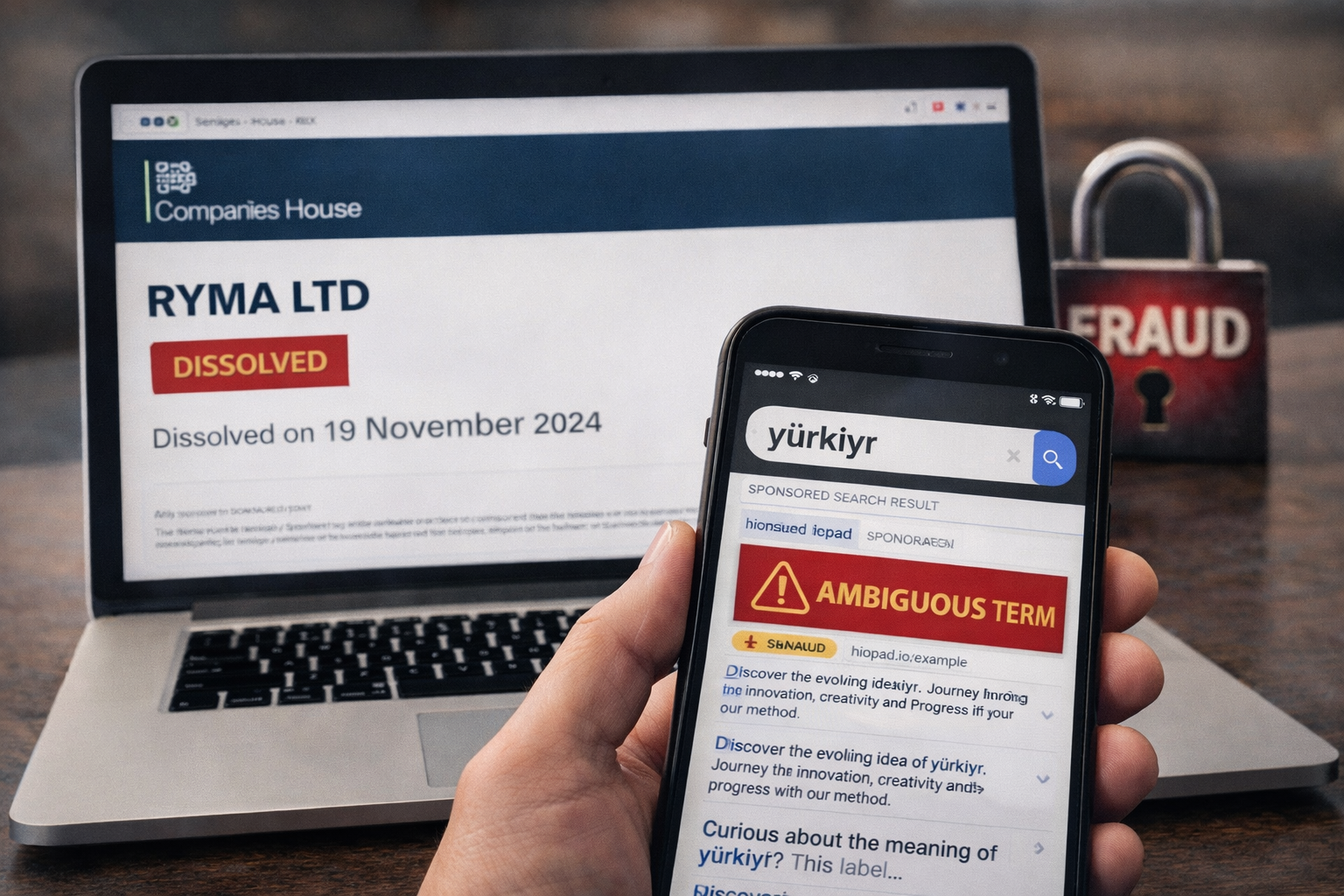
That is why the keywords Ryma Ltd and “yürkiyr” are worth examining together. On one side is a formal corporate label. UK public filings show RYMA LTD (company number 12207042) was dissolved on 19 November 2024, according to Companies House. On the other side is a term that has appeared across recent online posts with inconsistent explanations. Some websites describe “yürkiyr” as an evolving idea linked to progress and creativity, while others frame it as a method or brand identity, and there is no clear, widely accepted definition in authoritative reference works.
The financial significance is not that either keyword is “good” or “bad.” It is that the internet often treats names as assets. They can be bought via ads, recycled in marketing, or repurposed in scams long after the original context changes. That gap between what a name appears to mean online and what it actually represents in verifiable records is where risk concentrates.
In the United States, the FBI’s Internet Crime Complaint Center reported that losses tied to cyber and online crime exceeded $16 billion in 2024, underscoring how large the fraud economy has become. The US Federal Trade Commission has also said investment scams are among the fraud categories associated with some of the largest reported losses it tracks. Those headline figures are driven by many tactics, but a common starting point is simple: a search, a click, a convincing page, and a payment that is difficult to reverse.
When a company name becomes just another keyword
In the offline world, a company’s legal status is a matter of record. In the online world, it can be a matter of perception. Someone can see the words “Ryma Ltd” in a search result, on an invoice template, in a social media bio, or inside a message thread, and assume it refers to an operating business. Public records may say otherwise.
Companies House entries indicate RYMA LTD (12207042) is dissolved, with the dissolution dated 19 November 2024. A dissolved company does not automatically imply wrongdoing. Businesses close for many reasons. But from a risk perspective, “dissolved” changes what a name can credibly support. It can affect how counterparties judge a claim, how a bank reviews a payment dispute, or how an advertiser interprets a brand-safety report. The challenge is that most people do not check registers before they click or pay.
This matters because criminals and low-quality marketers often prefer ambiguity. A name that sounds like a legitimate company can help an ad convert. A name that has existed in the past can make a landing page look older and therefore more “real.” Even when a brand is unrelated to a scam, its name can be used as bait to drive traffic into unrelated funnels. The incentives are structural: in many ad markets, the first goal is attention, and attention can be monetised in multiple steps.
Financial firms tend to experience the problem downstream, after money has moved. By the time a complaint is filed, the initial click trail may be hard to reconstruct. Disputes may arrive as “I paid a company but I’m not receiving services,” or “I invested through a platform and can’t withdraw,” or “I sent money after seeing a brand in search ads.” Those are not always crimes, but the overlap is large enough that banks and platforms treat keyword-driven journeys as an operational risk.
What “yürkiyr” tells us about the modern trust gap
The keyword “yürkiyr” is the opposite of a formal corporate listing. It is not a standard financial term. It is not clearly defined in mainstream dictionaries. Recent web posts describe it in different ways sometimes as a cultural idea, sometimes as a digital identity label, sometimes as a “framework.” That variety is the point: when a term has no stable meaning, it is easier to attach it to almost anything.
Some posts claim the spelling is connected to Turkish language roots tied to “walking” or “moving forward.” A safer, verifiable statement is that Turkish words such as “yürü” and “yürümek” relate to walking/advancing, as shown in Turkish language references and etymology sources. There are also historically documented Turkish terms connected to that root (for example, “Yörük/Yürük”), though that is not the same thing as the modern internet spelling “yürkiyr.”
In finance and commerce, this kind of ambiguity matters because branding often borrows signals of legitimacy. New terms can be used to suggest novelty, exclusivity, or insider knowledge. In the best case, it is harmless marketing. In the worst case, it is the front-end of a fraud funnel, where a buzzword becomes the wrapper around a request for money or personal data.
That risk is amplified by the way digital distribution works. Search engines, social networks, and ad exchanges are optimised for engagement. If “yürkiyr” begins trending in small communities or gets repeated by multiple sites, ad buyers can bid on it and place sponsored links in front of people who are trying to understand it. A user who is curious, confused, or in a hurry is more likely to click the first credible-looking result.
This is where the keyword economy meets the fraud economy. Regulators and law enforcement have repeatedly warned that scams increasingly mimic legitimate finance. The FTC’s reporting shows that investment scams can produce large losses, and the FBI’s data highlights how large online-crime losses have become overall. The connection is not that every new word is a scam. The connection is that modern scams are distribution-led. They spread like marketing because they are marketing just with criminal intent.
Why this is a finance story, not just an internet story
For markets, the practical question is not “what does yürkiyr mean?” It is “how does attention turn into transactions, and who carries the risk when trust is misplaced?”
The costs land in several places:
First, consumers and small businesses can lose money, time, and identity data. Even when a payment is not fraudulent, confusion over a name can lead to misdirected transfers, wrong invoices, or wasted spend.
Second, banks and payment providers shoulder operational burdens: more fraud claims, more disputes, more compliance work. Those costs rarely show up as dramatic headlines, but they influence how frictionless payments can be, how quickly new accounts are opened, and how aggressively firms warn customers at the point of payment.
Third, platforms and ad-tech firms absorb moderation and brand-safety costs. As scams evolve, platforms can be pressured to improve detection and to respond faster to reports. That can raise expenses, increase false positives, and trigger tension between growth goals and safety goals.
Finally, legitimate businesses can be harmed by lookalikes and keyword confusion. If “Ryma Ltd” appears in search results alongside unrelated offerings, a user may associate a dissolved company name with something current. If “yürkiyr” is used as a brand label by multiple unrelated parties, customers can struggle to identify the official product, the official domain, or the real point of contact.
None of this requires dramatic claims. It is basic risk management: names travel faster than verification.
Table
| Keyword | What is clearly verifiable | What is often unclear online | Why it matters financially |
|---|---|---|---|
| Ryma Ltd | Companies House shows RYMA LTD (12207042) was dissolved on 19 Nov 2024. | Whether a site, ad, or message using the name reflects a current, operating entity | Counterparty checks, invoice trust, dispute handling, and brand misuse risk |
| yürkiyr | No stable, authoritative definition; online posts describe it inconsistently. Root words like Turkish “yürü/yürümek” relate to walking/advancing. | Whether it refers to a product, a framework, a community label, or a marketing hook | Ambiguity can be exploited in ads, impersonation, and “too-good-to-be-true” funnels |
Conclusion
Rma Ltd and “yürkiyr” show the same underlying problem from different directions. One is a formal corporate name with a status that can be checked in public filings. The other is an internet term with shifting meanings and no single trusted definition. In a digital economy where search and advertising can turn curiosity into clicks and clicks into payments those gaps in clarity can translate into real financial harm. With online-crime losses remaining high, the pressure on platforms and payment firms to narrow the trust gap is likely to continue.
FAQQ1: Is Ryma Ltd currently active in the UK?
Companies House shows RYMA LTD (12207042) as dissolved, with dissolution dated 19 November 2024.
Q2: Is “yürkiyr” an official financial term?
There is no clear evidence it is an established finance term. Recent online posts describe it in different ways, and the meaning appears context-dependent.
Q3: Why do ambiguous keywords matter in finance?
Because ambiguity can be monetised through ads and can be exploited by impersonation or misleading pages, which may increase the risk of payment disputes and fraud losses.
Q4: What’s the link to broader scam losses?
US agencies report large and rising losses tied to online crime and investment scams, highlighting how digital distribution channels can be used to scale harm.